Material comparison
Concrete vs. Pavers for a York, PA Patio
Concrete and interlocking pavers can both create durable outdoor rooms, but they behave and age differently. A fair comparison starts below the visible surface, defines the edge and drainage plan, and considers how the owner wants to maintain or repair the patio over time.
Our verdict
Choose concrete for a continuous, lower-joint surface; choose pavers for modular repair and unit-by-unit design.
Neither material wins every property. Our concrete-focused recommendation is a well-planned poured slab when the homeowner values a clean continuous surface, efficient placement, and either a simple broom or integrated decorative finish. Pavers deserve consideration when modular replacement, intricate unit patterns, or future lifting and reinstallation are the priority.
The comparison starts below the surface
Both systems depend on excavation, drainage, and a stable base. The details are not interchangeable: concrete is placed as a slab with planned joints, while interlocking pavers rely on a layered system of base, bedding, units, filled joints, and edge restraint. A vague proposal that names only the visible material leaves the most important construction questions unanswered.
We recommend comparing contractors' written base and drainage descriptions before debating color. Ask how weak or wet soil is addressed, how each layer is compacted, and where runoff will go. York County properties can include old fill, additions, removed decks, downspouts, and narrow access; those conditions affect both material systems.
Movement, joints, and repair
Concrete shrinks as it dries and also responds to temperature and moisture. Contraction joints create planned locations for cracking, while isolation joints separate the slab from structures or fixed objects where appropriate. Joints do not make a slab crack-proof, but a deliberate plan manages where movement is most likely to show.
Pavers have joints between every unit. Individual units can be lifted for some repairs or subsurface access, which is a genuine advantage when matching units remain available and the surrounding system can be restored correctly. The tradeoff is that the joint and edge system needs attention; loss of joint material, movement, weeds in accumulated surface debris, or edge failure can affect appearance and alignment.
Cleaning and ownership routine
A broom-finished concrete patio has no field of unit joints to refill. Cleaning is generally straightforward, although stains, joints, sealers on decorative work, and winter chemicals still require informed care. Repairs to a continuous slab may remain visible, especially if color and texture have weathered.
Paver maintenance may include cleaning, replenishing compatible joint material, correcting isolated movement, and monitoring edge restraint. Pavers are not automatically weed-free: weeds usually establish in material that collects at the surface rather than growing from deep below a properly constructed system. Pressure washing or harsh cleaning can disturb joints if performed carelessly.
Design, comfort, and accessibility
Concrete can be broom finished for visual simplicity or stamped and colored for a more decorative surface. Curves and broad uninterrupted areas can be efficient, and joints can be aligned with doors, corners, borders, or geometry. The exact finish should be assessed for traction and furniture use.
Pavers provide many unit shapes, laying patterns, colors, borders, and replaceable accents. The unit edges and joint width affect rolling furniture, small wheels, and walking comfort. For either material, a patio must be sized around real furniture and routes; an expensive pattern does not compensate for a cramped layout or poor step transition.
A decision framework for York homeowners
Choose concrete when you prefer fewer surface joints, a clean broom finish or integrated stamped texture, and a scope that can be placed as a coordinated slab. Choose pavers when modular units, targeted lifting, and detailed patterning are worth the additional joint and edge system. If roots, utilities, or future changes make access below the patio likely, include that in the decision.
Request two complete scopes for the same usable plan. Compare base preparation, water management, thresholds, steps, finish, maintenance, repair approach, and warranty language. The most useful answer is not a universal winner; it is the system whose tradeoffs match the property and the owner's maintenance expectations.
Documented portfolio example
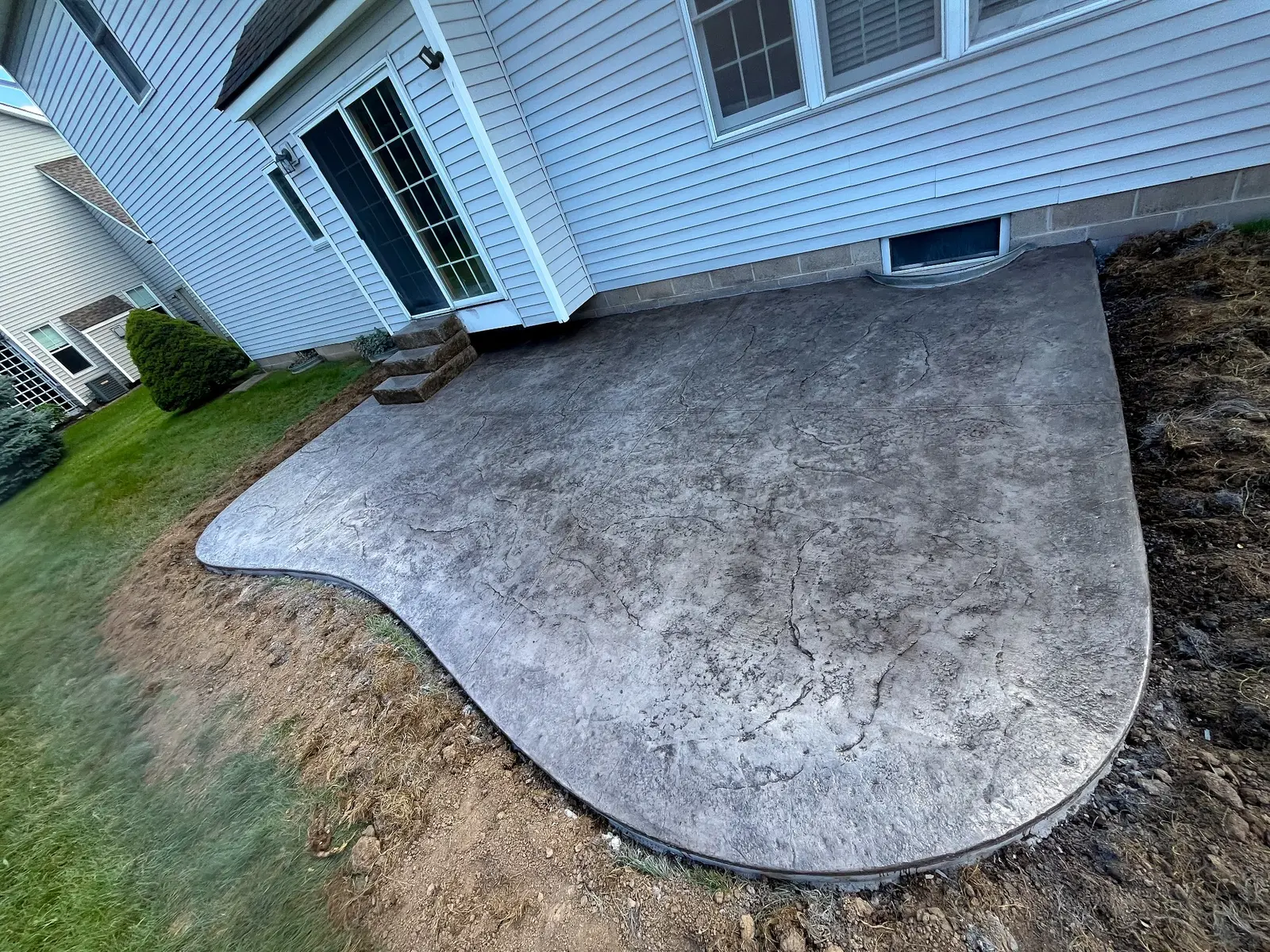
What this real project helps explain
The continuous slab supports a broad curved edge without a field of individual units. A paver version could create a similar outline, but its proposal should also define edge restraint, cuts, joint material, and how the curve will be maintained.
Disclosure: This is a shared-team portfolio example. We identify the town only when the project location has been verified; otherwise we do not present it as York County work.
Primary sources
Read the technical guidance behind this article
These links are provided for homeowners who want to verify the underlying industry or government guidance. Final specifications still need to reflect the property, materials, weather, and applicable local requirements.
- CIP 6: Joints in Concrete Slabs on Grade National Ready Mixed Concrete Association
Explains contraction, isolation, and construction joints and the reasons joints are planned in slabs on grade.
- Construction of Interlocking Concrete Pavements Concrete Masonry & Hardscapes Association
Industry guidance on interlocking-paver construction, including base, bedding, edge restraint, joints, and compaction.
- Maintenance and Repair of Interlocking Concrete Pavement Concrete Masonry & Hardscapes Association
Industry technical guidance for maintenance and repair considerations specific to interlocking pavement.