Weather & durability
Freeze-Thaw Concrete Guide for York, PA Homeowners
York's exterior concrete must handle wetting, cold weather, snow, ice, and repeated temperature changes. Durable results come from a complete system: appropriate concrete, stable drainage, correct placement and finishing, planned joints, curing, and informed winter maintenance.
Our verdict
Drainage and sound installation matter more than a miracle sealer.
For exterior concrete exposed to freezing, we prioritize an appropriate air-entrained mix, positive drainage, disciplined finishing, timely curing, and a joint plan. Sealer may support a specific surface system, but it cannot compensate for poor base conditions, trapped water, overworked concrete, or careless deicer use.
What freeze-thaw damage is
Concrete contains pores. When sufficiently saturated concrete freezes, water expands and creates internal pressure. Repeated cycles can contribute to scaling, surface deterioration, or deeper damage, especially when the concrete is vulnerable or remains wet. Entrained air provides a system of microscopic air spaces that helps relieve pressure in concrete designed for freezing exposure.
Freeze-thaw is not the explanation for every crack or surface mark. Drying shrinkage, restraint, settlement, impact, finishing problems, chemical exposure, and overloading can create different symptoms. A responsible assessment starts with when the issue appeared, where water travels, what products were used, and how the slab was designed and maintained.
Mix selection and water at the surface
The contractor and ready-mix producer should coordinate concrete suited to the exposure and placement. Air content, water-cementitious ratio, strength, aggregate, temperature, travel time, and placement method are related decisions. Jobsite water added without control can change workability and performance; surface water used as a finishing shortcut can weaken the top layer.
NRMCA finishing guidance warns against finishing while bleed water is present and against sprinkling water or cement onto the surface. Timing matters because exterior flatwork must be consolidated, struck off, floated, edged, jointed, textured, and protected without sealing water beneath a prematurely closed surface.
Drainage is a durability detail
Concrete that drains and dries has less opportunity to remain saturated before a freeze. The patio should direct water away from the house and toward a safe destination without creating a trip edge or dumping runoff where it causes another problem. Downspouts, sump outlets, roof valleys, lawn grades, walls, and snow-storage areas all affect the water plan.
Base and edge conditions matter too. Soft, pumping, or poorly drained support can contribute to movement. Soil piled against an edge can hold moisture; blocked outlets can turn a once-correct slope into a pond. Inspect drainage after landscaping changes, gutter work, or settlement rather than assuming it stays unchanged forever.
Cold-weather placement and curing
Cold-weather concreting is a planned operation, not simply a normal pour with a blanket added at the end. Subgrade condition, concrete temperature, accelerators if used, placement timing, protection, strength development, and the removal of protection need coordination. Concrete should not be placed on frozen subgrade or against ice and snow.
Curing controls moisture and temperature so concrete can develop intended properties. The exact method may use curing compound, wet coverings, plastic, insulated blankets, or a compatible combination. Decorative finishes and future sealers can affect product choices. Ask for the curing method in the scope and follow the contractor's timeline before loading, washing, sealing, or exposing the slab to harsh chemicals.
Joints, cracking, and winter maintenance
Concrete changes volume, so joints are used to manage movement. Contraction joints create weakened planes; isolation joints separate the slab from fixed elements where needed; construction joints occur where placements stop. Joint spacing, depth, timing, and layout depend on slab thickness, geometry, reinforcement, and conditions. Even a good plan cannot promise crack-free concrete.
For winter care, remove snow with tools that will not gouge the finish and keep drains and edges open. Avoid assuming every ice-melting product is safe for new concrete. Follow the contractor's written first-winter guidance and the product manufacturer's directions. Do not use fertilizer or unverified chemical blends as deicers, and remember that tracked road salts may reach the patio even if none are intentionally applied there.
Our clear durability priorities
We would spend attention first on site drainage, concrete suited to exposure, controlled placement, correct finishing, curing, and joints. A sealer is a product choice within that system, not the system itself. Decorative concrete may use sealer for color and surface appearance, while plain broom-finished concrete may have a different maintenance plan.
Homeowners should receive a simple care sheet that states when the patio can be walked on, furnished, washed, sealed if applicable, and exposed to winter chemicals. Keep that document with the estimate and mix or product information. If a surface issue develops, those records make a technical conversation more useful than guessing years later.
Documented portfolio example
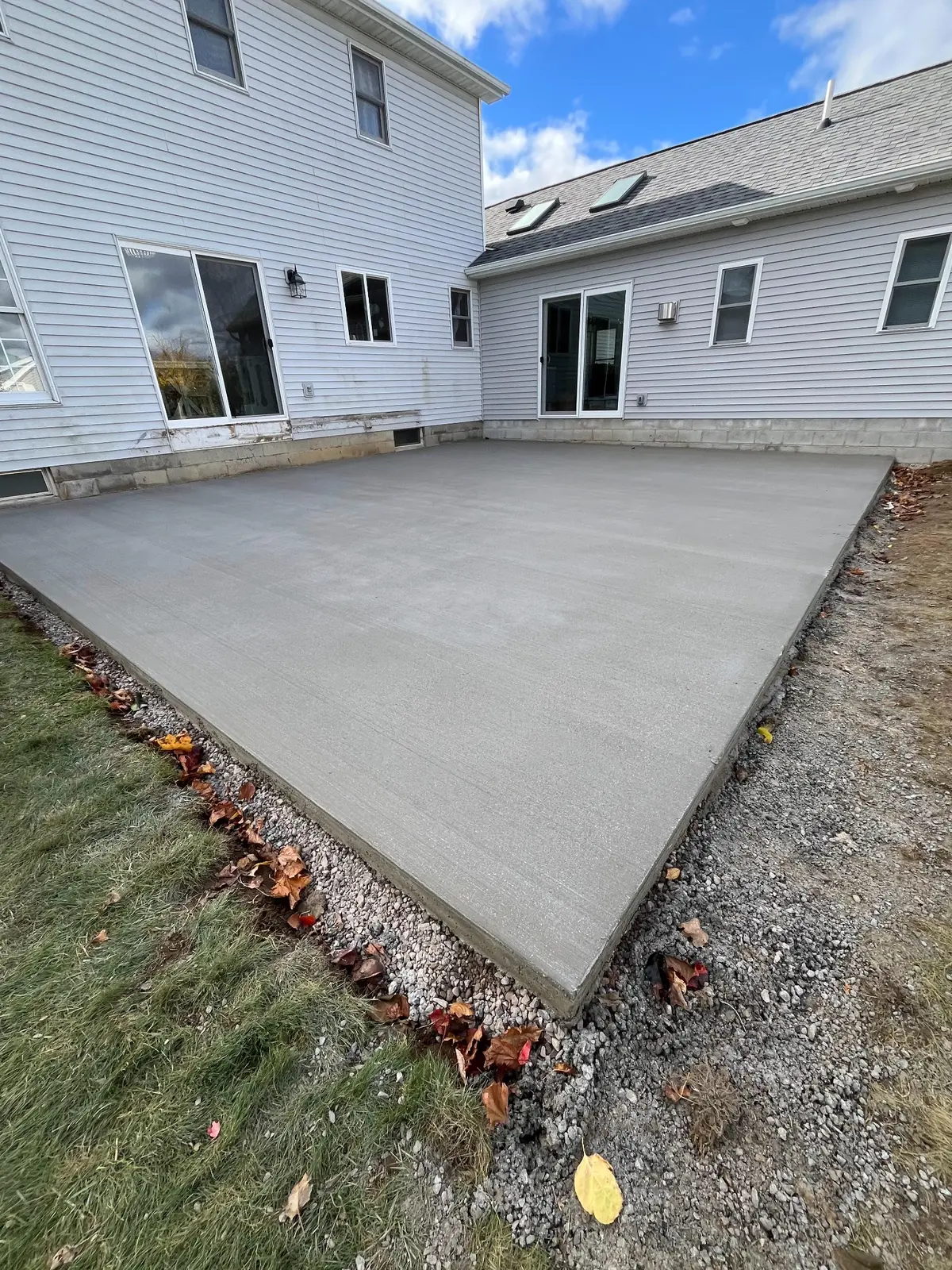
What this real project helps explain
The visible lesson is that texture, joints, edges, and slope are one system. None of those details alone guarantees winter durability; they must work with the mix, base, curing, drainage, and maintenance plan.
Disclosure: This is a shared-team portfolio example. We identify the town only when the project location has been verified; otherwise we do not present it as York County work.
Primary sources
Read the technical guidance behind this article
These links are provided for homeowners who want to verify the underlying industry or government guidance. Final specifications still need to reflect the property, materials, weather, and applicable local requirements.
- CIP 27: Cold Weather Concreting National Ready Mixed Concrete Association
Field guidance on cold-weather planning, temperatures, protection, strength development, and avoiding frozen support conditions.
- CIP 11: Curing In-Place Concrete National Ready Mixed Concrete Association
Explains curing's role in moisture retention, temperature control, strength, and durability.
- CIP 14: Finishing Concrete Flatwork National Ready Mixed Concrete Association
Addresses finishing sequence, bleed water, surface water, texture, jointing, and frequent workmanship errors.
- CIP 6: Joints in Concrete Slabs on Grade National Ready Mixed Concrete Association
Explains joint types and the role of planned joints in slabs on grade.